
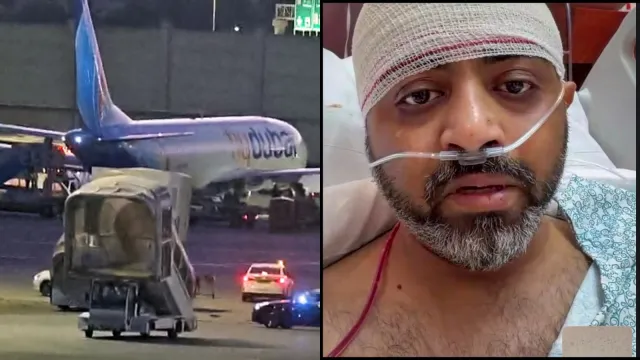
A shocking incident aboard a Flydubai flight has raised serious questions about airline safety, pilot background checks and cockpit security. A flight travelling from Dubai to Tel Aviv was diverted to Saudi Arabia after an alleged violent fight between two pilots, during which the captain was reportedly stabbed by his co-pilot. The incident has drawn international attention and raised an important question: How was a pilot accused of such violence allowed to operate a commercial aircraft carrying passengers?
The incident took place on September 30, 2026, aboard Flydubai flight FZ1073. While investigations are underway, several details about the alleged attacker, his background and his possible motive remain unclear.
What Happened on the Flydubai Flight?
According to reports, Flydubai flight FZ1073 was travelling from Dubai to Tel Aviv when a serious altercation reportedly broke out inside the cockpit.
Israeli officials said the aircraft rapidly lost altitude during the incident, dropping from approximately 33,000 feet to 17,000 feet within about a minute.
Israeli Prime Minister Benjamin Netanyahu said the captain, identified as Indian national Smit Machchhar, was stabbed by his co-pilot. The co-pilot allegedly attempted to crash the aircraft, although investigators will need to establish the full sequence of events.
Despite his injuries, Machchhar reportedly managed to open the cockpit door. Passengers and crew members then helped overpower the alleged attacker.
The aircraft eventually landed safely in Tabuk, Saudi Arabia. Both pilots sustained injuries and received medical treatment.
A separate Flydubai aircraft was later sent to Saudi Arabia to transport the stranded passengers to Israel.
The incident could have had devastating consequences. However, the actions of the captain, together with the assistance of other people on board, helped prevent a potential tragedy.
How Was the Co-Pilot Cleared to Fly?
One of the biggest questions is how the co-pilot passed the checks required to work for a commercial airline.
Flydubai operates under the aviation regulatory system of the United Arab Emirates (UAE). The country’s General Civil Aviation Authority (GCAA) is responsible for overseeing the airline’s certification and relevant operational safety requirements.
Commercial pilots must meet several professional and medical requirements before they can fly passengers.
These generally include:
- A valid professional pilot licence.
- Appropriate qualifications and training for the aircraft type.
- A current Class 1 medical certificate.
- Sufficient flight experience and continued training.
- Required English-language proficiency.
- Compliance with applicable airline and aviation safety requirements.
The medical certification process assesses a pilot’s physical and mental fitness to perform safety-critical duties. Where relevant medical concerns arise, additional examinations or specialist assessments may be required.
However, passing these checks does not guarantee that a person will never develop serious problems or behave violently in the future.
Aviation analyst Saj Ahmad told Al Jazeera that pilot vetting can be thorough, but checks provide only a picture of a person’s condition at a particular time.
This is an important distinction. A pilot can meet all the required standards during recruitment but later develop personal, psychological or workplace problems that were not apparent during earlier assessments.
At present, there is no publicly confirmed evidence establishing that the co-pilot had a known medical condition, failed a previous assessment or had a history of violent behaviour. It would therefore be premature to conclude that the airline or regulators overlooked a specific warning sign.
Can Background Checks Prevent Such Incidents?
Airlines and aviation authorities use multiple layers of safety checks to reduce the risk of dangerous behaviour.
These may include identity verification, employment history checks, security screening, medical assessments, simulator evaluations and regular performance reviews, depending on the applicable rules.
However, no screening system can predict every future action.
For example, a person may pass a medical examination and perform well during training but later experience a personal crisis or develop problems that affect their behaviour. Unless warning signs are recognised and appropriately reported, these changes may not become apparent to an employer.
This is why aviation safety cannot depend on recruitment checks alone.
Airlines also need effective systems for reporting concerning behaviour, assessing fitness for duty and responding to warning signs without discouraging employees from seeking help.
At the same time, mental health concerns should not automatically be treated as evidence that someone is dangerous. Decisions about a pilot’s fitness must be based on proper medical assessment and reliable evidence rather than assumptions.
The key challenge is to identify genuine safety risks while protecting the privacy and rights of aviation professionals.