
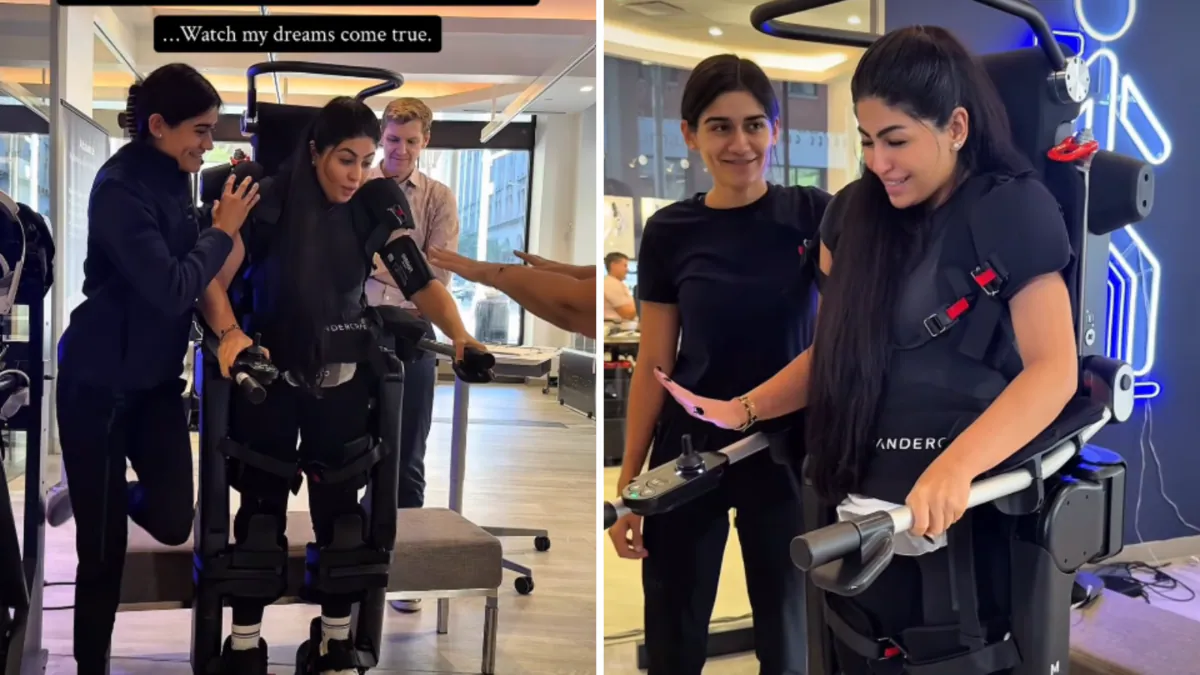
A woman who has lived with paralysis for more than a decade has experienced an emotional moment after a robotic device helped her stand and take assisted steps. Jessica Tawil, a Lebanese woman who suffered a spinal cord injury in a car accident in 2014, repeatedly exclaimed, “Oh my God!” as she experienced the movement with the help of a wearable robotic device called Eve. The video has drawn attention online, highlighting how assistive technology can create meaningful experiences for people living with mobility challenges. Her reaction is a reminder that even a few supported steps can carry deep personal significance after years of relying on a wheelchair.
Who Is Jessica Tawil, the Woman Whose Video Is Going Viral?
Jessica Tawil is a Lebanese woman who has lived with paralysis since a car accident in 2014. According to the News18 report, she was just 16 years old when the accident caused a spinal cord injury that resulted in T6 paraplegia.
Paraplegia affects movement and sensation in the lower part of the body. The extent of its effects can vary depending on the location and severity of the spinal cord injury.
Since the accident, Tawil has used a wheelchair for mobility and adapted to life with the condition. Her recent video has attracted attention because it shows her experiencing supported standing and stepping with the help of robotic technology.
For someone who has spent years living with limited mobility, the opportunity to experience these movements can be deeply emotional.
Her ‘Oh My God!’ Reaction Captures an Emotional Moment
In a video shared on Instagram, Tawil can be seen using a wearable robotic device called Eve. As the machine supports her body and helps her take steps, she repeatedly says, “Oh my God!”
Her reaction conveys the excitement and emotion of the experience. The video has resonated with viewers because it captures a personal moment rather than simply demonstrating a piece of technology.
Standing upright and taking assisted steps may seem like ordinary activities to many people. However, for someone living with paralysis, these movements can represent a very different experience.
The video also highlights the emotional side of living with a spinal cord injury. Along with physical challenges, people may have to adjust their daily routines, independence and expectations about mobility.
Tawil’s experience offers a glimpse into how assistive devices can help people explore movement in ways that may not otherwise be possible for them.
How Does the Eve Robotic Device Help Her Walk?
Eve is a wearable robotic exoskeleton designed to assist movement. Such systems use mechanical support to help a person maintain an upright position and perform movements such as standing and stepping.
Unlike an ordinary walking aid, a robotic exoskeleton is designed to support specific body movements through its mechanical structure and control system. The level of assistance depends on the device’s design and the needs of the person using it.
These systems may be used in supervised rehabilitation or other approved settings, depending on the particular device and its intended purpose.
However, using a robotic exoskeleton does not necessarily mean a person has regained independent movement. In Tawil’s video, the device provides assistance that enables her to stand and take supported steps.
The technology should therefore be understood as a form of mobility assistance, not proof that paralysis has been reversed.
What Is T6 Paraplegia and How Does It Affect Daily Life?
T6 paraplegia refers to paralysis associated with an injury around the sixth thoracic level of the spinal cord. The thoracic region is located in the middle portion of the back.
A spinal cord injury can interrupt communication between the brain and parts of the body below the affected area. Depending on the injury, a person may experience reduced or absent movement and sensation in the legs.
The condition can also affect everyday activities, including getting around, transferring between a wheelchair and a bed, and managing personal care.
The impact varies from person to person. Some people may retain certain movements or sensations, while others may have more extensive limitations.
With appropriate rehabilitation, assistive equipment and support, people with spinal cord injuries can work towards greater independence and participation in daily life. Their needs and goals are individual, and progress cannot be measured by walking alone.
Can Robotic Exoskeletons Help People With Paralysis Walk Again?
Robotic exoskeletons are attracting interest in rehabilitation because they can provide mechanical assistance for standing and stepping.
Depending on the device and the user, potential benefits may include practising upright movement, participating in supervised rehabilitation activities and experiencing supported mobility.
However, the results are not the same for everyone. A person’s medical condition, injury level, physical abilities and the design of the device all influence whether an exoskeleton is appropriate.
These machines also have limitations. They may require trained supervision, suitable fitting, specialised equipment and careful assessment before use.
Most importantly, taking steps with a robotic device is not the same as recovering the ability to walk independently. Any claim about improved function or long-term recovery needs to be supported by appropriate clinical evidence.
Tawil’s video demonstrates an assisted movement experience. It does not, by itself, establish that the device has restored her natural ability to walk.
Eve’s Reported FDA Clearance Brings More Attention to the Technology
According to the News18 report, Tawil shared an update in August 2026 stating that Eve had received clearance from the US Food and Drug Administration (FDA).
Such regulatory developments can be important for medical technology, but the exact clearance and its intended use need to be considered when assessing what a device can do.
FDA clearance does not mean that a device can cure paralysis or produce the same results for every user. Its permitted use, supporting evidence and safety requirements depend on the specific regulatory decision.
The development has nevertheless brought more attention to the possibilities of wearable robotics and the role these systems may play in mobility support.
What This Technology Could Mean for People in India
For Indian families affected by spinal cord injuries, stories like Tawil’s may encourage greater awareness of rehabilitation and assistive technology.
People living with mobility impairments may need access to physiotherapy, wheelchair services, home modifications and equipment that supports everyday independence. Robotic exoskeletons represent one area of technological development, although availability, affordability and suitability can vary considerably.
In India, access to specialised rehabilitation services and advanced equipment may also differ between cities and rural areas. Cost, trained professionals and the availability of follow-up care can influence whether a person can use such technology.
Families considering an exoskeleton should consult qualified rehabilitation specialists and seek an assessment of the individual’s medical condition, goals and safety needs. They should also check the device’s regulatory status, intended use and total cost before making decisions.
Technology can offer valuable options, but it should complement appropriate medical care and rehabilitation rather than replace them.
A Powerful Reminder of Human Resilience
Jessica Tawil’s emotional reaction has brought attention to the personal meaning that supported movement can have after years of living with paralysis.
Her experience also highlights the progress being made in assistive technology and the importance of developing solutions that help people participate more fully in life.
At the same time, it is essential to understand the difference between robot-assisted movement and independent walking. The video does not establish that Tawil has recovered from paralysis, but it does show a meaningful moment in her experience with mobility assistance.
For many people living with disabilities, progress can take different forms. Greater independence, access to suitable equipment and the ability to participate in everyday activities can all make a difference.