
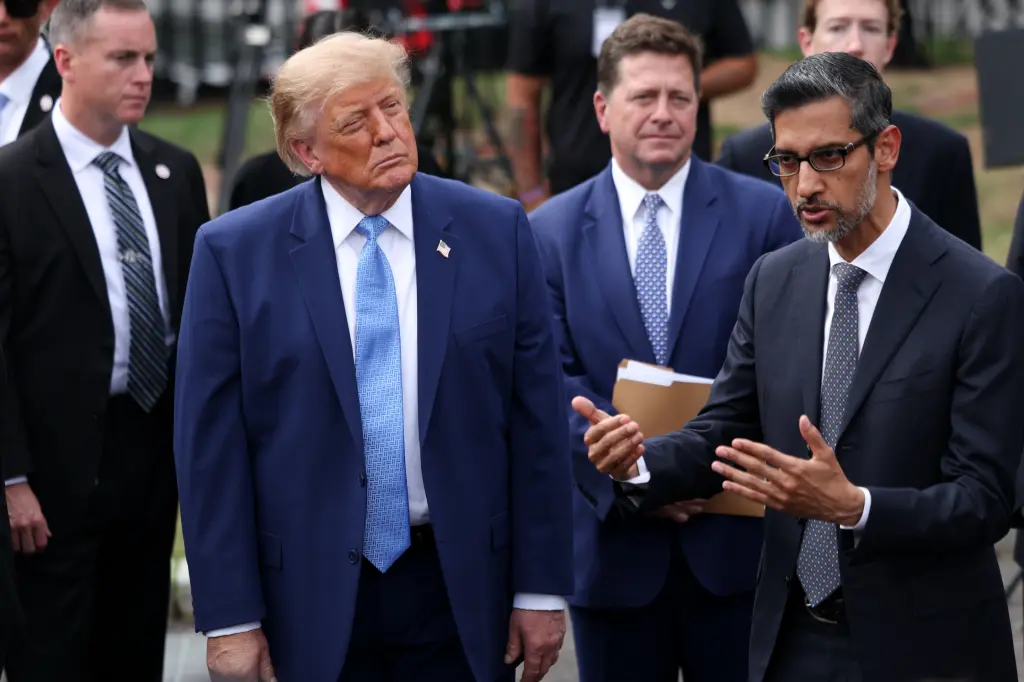
US President Donald Trump has reportedly explored another unusual name change, this time involving the Atlantic Ocean. However, according to Trump, Google CEO Sundar Pichai was not willing to go along with the idea. Trump claimed that when he discussed renaming the Atlantic Ocean, Pichai explained that oceans are different because they span multiple countries. The reported response has attracted attention worldwide, putting the spotlight on Trump’s interest in changing geographical names and the role of technology companies such as Google in deciding what millions of people see on digital maps.
The episode comes after earlier changes involving the Gulf of Mexico and Lake Ontario. While Trump has pushed for names that reflect American identity, the latest proposal raises an important question: Can one country or its president change the name of a geographical feature shared by many nations?
What Did Donald Trump Say About Renaming the Atlantic Ocean?
Trump spoke about the proposal during a rally in South Carolina on October 21, 2026. According to his account, he contacted Google Maps to discuss the possibility of changing the Atlantic Ocean’s name.
Trump recalled asking Pichai whether Google could handle the proposal. He claimed the Google CEO responded, “No, no, no. This time, I’m not doing it.”
According to Trump, Pichai explained that oceans cover many countries and asked him not to pursue the idea.
Trump then appeared to indicate that he would probably drop the proposal, asking the crowd whether the Atlantic Ocean should simply keep its existing name.
However, Trump also mentioned another possibility: calling the Pacific Ocean the “American Ocean.”
It is important to note that these details come from Trump’s public account of the conversation. Google had not independently confirmed the exchange when Fortune published its report. The available information also does not establish that Google received a formal government request to rename the Atlantic Ocean. <Cite refs={[“turn134640search0″,”turn134640search1”]}/>
Why Did Trump Want to Rename the Ocean?
Trump has repeatedly expressed interest in geographical names that highlight the United States.
During his second presidential term, he supported renaming the Gulf of Mexico as the Gulf of America. He also signed an executive order in August 2026 directing US federal agencies to use the name Lake America for Lake Ontario.
These moves have made geographical naming part of a wider political conversation about national identity, government authority and the way countries present themselves.
Place names can carry historical, cultural and political meaning. Governments sometimes change names to reflect independence, local languages or a different understanding of history.
In India’s case, the renaming of cities and streets has also been discussed in connection with historical identity and cultural heritage. Such decisions can generate strong public reactions because people may view a name as more than just a label on a map.
Trump’s proposed ocean name, however, presents a different challenge. The Atlantic is not located entirely within the territory of one country. It borders or connects regions across North America, South America, Europe and Africa.
That makes an internationally recognised name much harder to replace than a name used by one country’s government.
How Did Google Maps Handle Earlier Name Changes?
Google Maps has previously reflected some of the US government’s geographical naming decisions.
Following the US decision to use “Gulf of America”, Google adopted that label for users in the United States. The company also introduced the Lake America name for US users following the change involving Lake Ontario.
However, the labels are not necessarily identical everywhere.
Google’s approach to these features has included displaying different names depending on the user’s country. For example, users in Mexico continue to see the Gulf of Mexico, while users outside the United States and Mexico may see both names.
Lake Ontario also continues to be called Lake Ontario for Canadian users. In other regions, Google may show the original name alongside the US designation.
This reflects a key point: a map label can vary by region without the international name of a geographical feature changing everywhere.
Google has explained that it uses official government sources when determining geographical labels and has a policy for handling bodies of water with different names in different countries. <Cite refs={[“turn134640search0″,”turn134640search1”]}/>
Can a US President Rename an Entire Ocean?
A US president can direct federal agencies to use a particular name for official US government purposes. But that does not automatically force other countries, international organisations or private companies to adopt the same name.
According to the Fortune report, the US Board on Geographic Names and its Foreign Names Committee play a role in determining names used by the federal government.
International naming practices also recognise that countries may disagree about the names of shared geographical features. United Nations guidance on geographical names supports the use of different national names when countries cannot agree on a common one.
This means that even if the United States decided to call the Atlantic Ocean something else in its official documents, other countries would not automatically have to follow.
The Atlantic Ocean is shared across a vast international region. Changing its globally recognised name would therefore be far more complicated than changing the label used by one national government.
Why Sundar Pichai’s Reported Response Matters
Pichai’s reported response has attracted attention because it highlights the limits of what a technology company can reasonably do with a request involving an international geographical feature.
Google Maps is used by people around the world for navigation, travel planning, education and business. Its labels can influence how users understand places, but the company does not independently determine every country’s official geographical terminology.
If a globally recognised ocean suddenly appeared under a politically controversial name, users in different countries could see conflicting information. That could create confusion in classrooms, news reports, travel information and other digital services.
The reported exchange also highlights the difference between complying with a country’s official naming sources for local users and changing an internationally shared name for everyone.
Still, Pichai’s exact response remains unverified by Google. It would therefore be inaccurate to present the reported conversation as an independently confirmed statement from the company.
What Does This Mean for India and Other Countries?
For Indian readers, the story offers a useful reminder that geographical names are not always simple or universally agreed upon.
India has a long history of place names reflecting languages, communities, kingdoms and historical events. Names can change over time, but their acceptance and use depend on official decisions, public familiarity and how the names are adopted by different institutions.
Digital maps add another layer to this process. A name used by a government may not immediately appear in exactly the same way across every international map service, publication or educational resource.
For international features such as oceans, rivers and seas that cross national boundaries, coordination becomes even more important.
A common name helps governments, researchers, travellers and ordinary users communicate clearly. When different countries use different names, map providers must decide how to present those differences without misleading users.
That is why a proposal to rename an entire ocean is not merely a question of changing a few words on Google Maps. It involves geography, international practice, government authority and public understanding.
The Final Word: Will the Atlantic Ocean Ever Become ‘Trump Ocean’?
For now, there is no confirmed global change to the name of the Atlantic Ocean. Trump has said that he discussed the idea with Google and that Pichai discouraged it, reportedly explaining that an ocean spanning multiple countries is different from a geographical feature named for use within one country.
The episode follows earlier US naming decisions involving the Gulf of Mexico and Lake Ontario, which Google Maps has reflected differently depending on the user’s location.
Whether Trump’s ocean proposal was a serious plan, a trial balloon or partly a joke remains unclear from the public account alone.
One thing is clear: changing a name on a digital map is not the same as changing an internationally recognised geographical name. And when a feature belongs to the shared geography of many nations, one country’s decision cannot automatically settle the question for the entire world.