
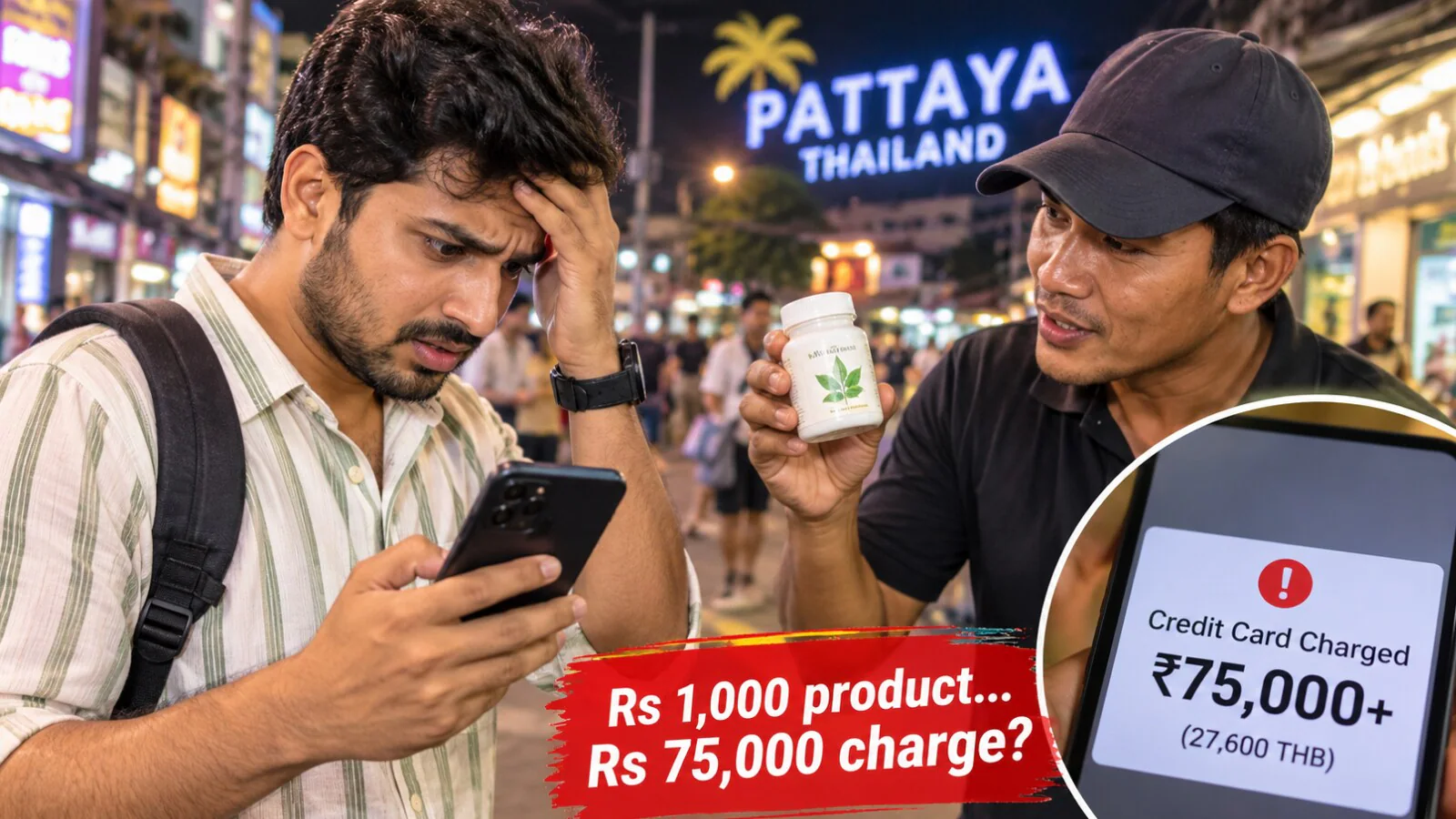
Imagine walking along a busy tourist street in Thailand when a stranger approaches you and offers a herbal product for around ₹1,000. You agree to buy it, thinking it is a small purchase. But when you check your credit card, you discover that nearly ₹75,000 has been charged. This is the shocking experience an Indian tourist reportedly faced in Pattaya, Thailand. The 28-year-old traveller approached the local police after discovering that his card had been debited 27,600 Thai baht, even though the product was initially offered for just 380 baht.
The incident has raised concerns about tourist scams involving herbal products and unexpected credit card charges. It also serves as a warning for Indian travellers visiting popular international destinations: always check the final amount before making a payment.
Indian Tourist Allegedly Charged ₹75,000 For A Herbal Product
According to reports, the incident took place on October 28, 2026, at around 11:30 pm on Pattaya Second Road in Thailand.
The 28-year-old Indian tourist was walking along the road when a man approached him and offered to sell a herbal product for 380 Thai baht. The tourist reportedly agreed to purchase it, believing that the quoted price was the final amount.
However, the situation took an unexpected turn when he discovered that his credit card had been charged 27,600 Thai baht.
The amount was more than 72 times the price initially mentioned by the seller. In Indian currency, the charge was reported to be over ₹75,000, while the original offer was worth approximately ₹1,000.
The tourist was shocked by the transaction and decided to approach Pattaya City Police to register a formal complaint.
Tourist Approaches Pattaya Police After Discovering The Charge
After discovering the unexpected debit, the Indian tourist reportedly went to Pattaya City Police and requested action against the people involved.
The complaint brought attention to concerns about sellers approaching visitors in popular tourist areas and offering herbal products at attractive prices.
According to the report, the tourist believed he was agreeing to a purchase worth only 380 baht. The much larger card transaction came as a shock.
The incident also raised questions about how the payment was processed and whether the final amount was clearly communicated before the transaction was authorised.
For international travellers, even a small misunderstanding involving a foreign currency can become an expensive problem, particularly when payments are made using credit cards.
Sellers Reportedly Offer A Refund After Police Complaint
The incident took another turn after the tourist approached the police.
According to the report, a person associated with the sellers contacted him soon afterwards and reportedly offered to refund the amount charged to his credit card.
The tourist was also asked to return the herbal product as part of the proposed settlement.
However, it was not clear from the report whether the refund had actually been completed.
The offer reportedly came after the tourist registered his complaint, adding another development to the incident.
Similar Herbal Product Complaints Reported In Pattaya
The latest incident has attracted attention because it is reportedly not the first complaint involving expensive herbal products in Pattaya.
In January 2026, another 45-year-old Indian tourist alleged that he had spent 43,400 Thai baht on herbal products after being approached by foreign men near Soi Marine Plaza.
Another complaint was reported in September involving a Sri Lankan tourist who allegedly paid 3,300 baht for a coconut-oil product promoted as a treatment for baldness.
In June, immigration officials reportedly arrested a Pakistani man suspected of working as an intermediary in a similar herbal-product operation.
These incidents have raised concerns about certain sellers operating in tourist areas and the need for visitors to be cautious when approached with unsolicited product offers.
However, these are separate reported incidents, and they do not establish that every herbal-product seller in Thailand is involved in wrongdoing.
Why Are Tourists Being Targeted With Herbal Product Offers?
Tourist destinations often have busy streets filled with shops, street vendors and people promoting different products and services.
Visitors may be approached with offers involving herbal oils, skincare products, supplements or items claiming to help with hair loss and weight management.
Such offers can sound attractive, particularly when sellers promise quick results or quote a low starting price.
The problem arises when tourists are not given clear information about the final cost or the payment process.
A traveller who is unfamiliar with the local currency may also find it difficult to quickly understand the amount displayed on a payment terminal.
For example, someone who hears a price of 380 baht may assume that the transaction is straightforward. But if the payment machine displays a different figure, failing to check it carefully can lead to a major financial loss.
This is why travellers should never allow anyone to rush them through a card payment.
How Indian Tourists Can Avoid Credit Card Scams Abroad
Indian travellers visiting Thailand or any other foreign country should follow a few simple precautions to protect themselves.
1. Always Confirm The Final Price
Before agreeing to buy anything, ask the seller to clearly confirm the final price. Do not rely only on a verbal offer.
2. Check The Payment Machine Carefully
Before entering your PIN or tapping your card, check the amount displayed on the payment terminal. If the figure is different from what you agreed to pay, stop the transaction.
3. Avoid Rushed Payments
Be careful if someone creates pressure by asking you to pay quickly. Take your time and understand the transaction before approving it.
4. Be Careful With Unsolicited Offers
If strangers approach you on the street and offer products claiming to cure hair loss, reduce weight or solve health problems, avoid making an immediate purchase.
5. Keep Transaction Alerts Active
Enable SMS and app notifications for your bank and credit card. This can help you identify unexpected transactions quickly.
6. Contact Your Bank Immediately
If you notice an unauthorised or incorrect charge, contact your card issuer immediately. Ask about blocking the card, raising a transaction dispute and the applicable chargeback process. Keep the transaction details and any supporting evidence.
What Should You Do If You Face A Similar Situation In Thailand?
If a tourist discovers an unexpected card charge, the first step should be to preserve all available evidence.
Keep the payment receipt, card transaction notification, product details and any messages exchanged with the seller. If possible, note the shop location and save photographs or other relevant information.
The traveller should then approach the local police and report the incident. They should also contact their bank or card issuer in India without delay.
If the situation becomes difficult to manage, Indian citizens can seek assistance from the Indian Embassy or the relevant Indian consular authorities in Thailand.
Travellers should remember that a police complaint and a bank dispute are separate processes. Reporting the incident does not automatically guarantee that the money will be refunded.
Thailand Trip? Be Careful Before Swiping Your Card
Thailand remains a popular international holiday destination for Indian tourists. From Bangkok’s shopping streets to Pattaya’s beaches and entertainment areas, thousands of visitors travel there to enjoy their holidays.
However, incidents like the reported ₹75,000 credit card charge show why travellers should remain alert even when making small purchases.
A product offered for a low price should never become an expensive surprise. Always confirm the amount, check the payment terminal and avoid buying products from strangers without understanding what you are paying for.
The Indian tourist’s complaint in Pattaya is a reminder that a few seconds spent checking a payment can prevent a major financial headache during an overseas holiday.