
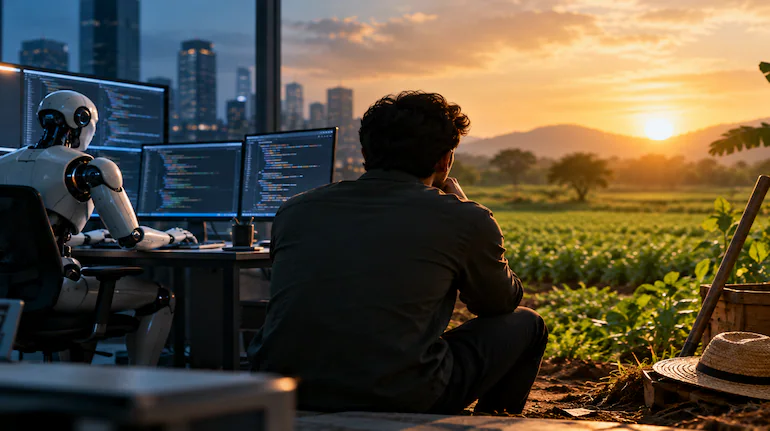
Artificial intelligence is changing the technology industry so quickly that even experienced software engineers are beginning to question their future. A software engineer with nearly a decade of experience has shared his concerns online, saying he is tired of trying to keep up with AI and is now considering growing his own food or taking up farming. His post has sparked discussions about job security, the future of coding and whether traditional technology careers will remain stable over the next five to ten years.
Why Is This Software Engineer Worried About AI?
The engineer shared his concerns in a post on Reddit’s Claude Code community. He described the current period as an extremely difficult time for people working in technology because AI tools are improving at a pace that many professionals find hard to follow.
senior engineers are considering farming because of AI 💀 https://t.co/lkE0JM90C1
— Adnaan (@adnaannasir_) October 25, 2026
According to his post, the constant changes have made him question whether conventional software development jobs will continue to offer long-term security.
He said he had previously believed that although AI could write code, experienced engineers would remain essential for designing complex systems and making important technical decisions. However, he feels that newer AI tools are becoming capable of handling tasks that once required considerable human expertise.
His concerns reflect a growing discussion within the technology industry. For many professionals, the question is no longer simply whether AI can write code. It is whether companies will need the same number of engineers when AI can complete more work in less time.
AI Is Moving Beyond Writing Basic Code
In the early stages of generative AI, many software developers viewed these tools mainly as assistants. They could suggest lines of code, explain programming concepts, identify simple errors and help developers complete repetitive tasks.
Today, AI coding tools can perform more complex activities, including generating entire functions, suggesting software architectures, debugging programs and assisting with testing. Some tools can also work across multiple files and follow instructions to complete several connected tasks.
The engineer said this progress had changed his earlier belief that system design would remain a major advantage for senior professionals.
He also questioned what would happen to traditional software businesses if AI could increasingly build websites, games and software-as-a-service products.
For example, a small business owner who once needed to hire a developer to create a basic website may now be able to build an initial version using AI tools. A startup may also use AI to develop and test a prototype with a smaller team.
However, building a working prototype is not the same as creating secure, reliable software that can serve thousands of customers. Human expertise remains important for checking accuracy, protecting data, understanding customer requirements and handling unexpected failures.
Why Even Experienced Engineers Feel the Pressure
For many years, experience was considered an important source of job security in the technology industry. Senior engineers develop knowledge of software architecture, business systems, security and the practical problems that arise when applications are used in the real world.
AI is challenging some of these assumptions by helping developers perform increasingly advanced tasks.
This does not automatically mean experienced engineers will become unnecessary. Instead, their responsibilities may change. They may spend less time writing routine code and more time reviewing AI-generated work, managing complex projects, checking security and deciding whether a solution meets business needs.
The difficulty is that workers must learn new tools while continuing to meet their existing deadlines.
For someone who has spent years mastering one programming language or technology, the arrival of new AI systems can create uncertainty. A skill that once provided a competitive advantage may become easier for others to acquire with AI assistance.
The engineer’s post captures this sense of exhaustion. His concern is not only about losing a job but also about the possibility of spending an entire career trying to catch up with technology that never stops changing.
Could Software Engineering Jobs Disappear in Five to Ten Years?
The engineer fears that conventional jobs may become much harder to find over the next five to ten years. However, this is his personal concern, not a confirmed prediction about the entire profession.
The future of software engineering will depend on how quickly AI improves, how businesses adopt it and whether demand for new digital products continues to grow.
Some tasks, particularly repetitive coding, basic testing and routine maintenance, may require fewer human working hours. Companies could use AI to reduce development costs or allow smaller teams to deliver more projects.
At the same time, cheaper software development could encourage businesses to build products they previously could not afford. This may create demand for professionals who understand customer needs, system integration, cybersecurity, cloud infrastructure and AI implementation.
The most likely outcome cannot be predicted with certainty. Some roles may shrink, others may change, and new opportunities may emerge.
For Indian software professionals, the important question is how to prepare for these changes without assuming either that every job is safe or that all technology jobs will disappear.
Why Is He Considering Farming Instead?
The engineer’s suggestion that he might grow his own food or take up farming has attracted attention because it represents a major change from a technology career.
For some professionals, farming may appear to offer a more tangible and independent way of living. Instead of spending the day in front of a computer and constantly learning new software, they may imagine working outdoors, producing food and building a different lifestyle.
In India, agriculture also has a deep connection with family land, rural communities and traditional livelihoods. Some urban professionals may therefore see farming as an alternative if they become dissatisfied with corporate life.
However, farming is not an easy escape from uncertainty. It involves unpredictable weather, water availability, crop diseases, changing market prices, labour costs and the possibility of financial losses.
A person who has spent a decade in software development may also need considerable practical knowledge before running a farm successfully.
Anyone seriously considering this change should learn about agriculture, understand local market demand and test the idea on a small scale before leaving a stable source of income.
What Does AI Disruption Mean for India’s IT Sector?
India has a large technology workforce, with major IT companies, startups and global capability centres employing professionals across software development, testing, support and business operations.
A rapid shift towards AI-assisted work could affect how these companies hire, train and organise their employees.
For example, entry-level developers may face greater competition for jobs involving routine coding. Companies may expect new employees to understand AI tools alongside programming fundamentals.
Experienced workers may also need to demonstrate that they can use AI responsibly, verify its output and solve problems that cannot be handled through simple instructions.
At the same time, demand for professionals who can deploy AI systems, manage data, secure applications and connect new tools with existing business software may create fresh opportunities. An industry report published in June 2026, for example, highlighted significant demand for AI-related skills in India, including deployment and governance.
This suggests that the challenge is not simply to learn one new AI tool. Workers need to understand how technology can solve real business problems.
How Can Software Engineers Prepare for the AI Era?
Instead of making a sudden career change because of fear, software professionals can take practical steps to improve their position.
First, they should learn how to use AI coding assistants effectively. Understanding how to give instructions, review generated code and identify errors can help developers become more productive.
Second, they should strengthen their fundamentals. Knowledge of databases, networking, software architecture, cybersecurity and system reliability remains valuable when AI-generated solutions need to be checked and maintained.
Third, developers can explore areas such as cloud computing, AI integration, data engineering and application security. Choosing a specialisation that matches their interests and experience may be more useful than trying to master every new tool.
Finally, professionals should build financial flexibility. Maintaining savings, avoiding unnecessary debt and exploring additional sources of income can make career changes less stressful.
A Growing Debate About the Future of Work
The software engineer’s post has opened up a wider conversation about the speed of AI development and the pressure it places on workers. His experience reflects the uncertainty some professionals feel as technology changes the value of their existing skills.
It is too early to conclude that software engineering will disappear within five to ten years. But it is reasonable to expect that the profession will look different as AI becomes more capable.
For India’s technology workforce, adapting to this change will be important. Learning new skills, understanding AI’s limitations and developing strong problem-solving abilities may help professionals remain competitive.
Whether this engineer eventually chooses farming or continues working in technology remains unclear. His post nevertheless raises an important question for millions of workers: how can people prepare for a future in which the skills they rely on today may not be enough tomorrow?