
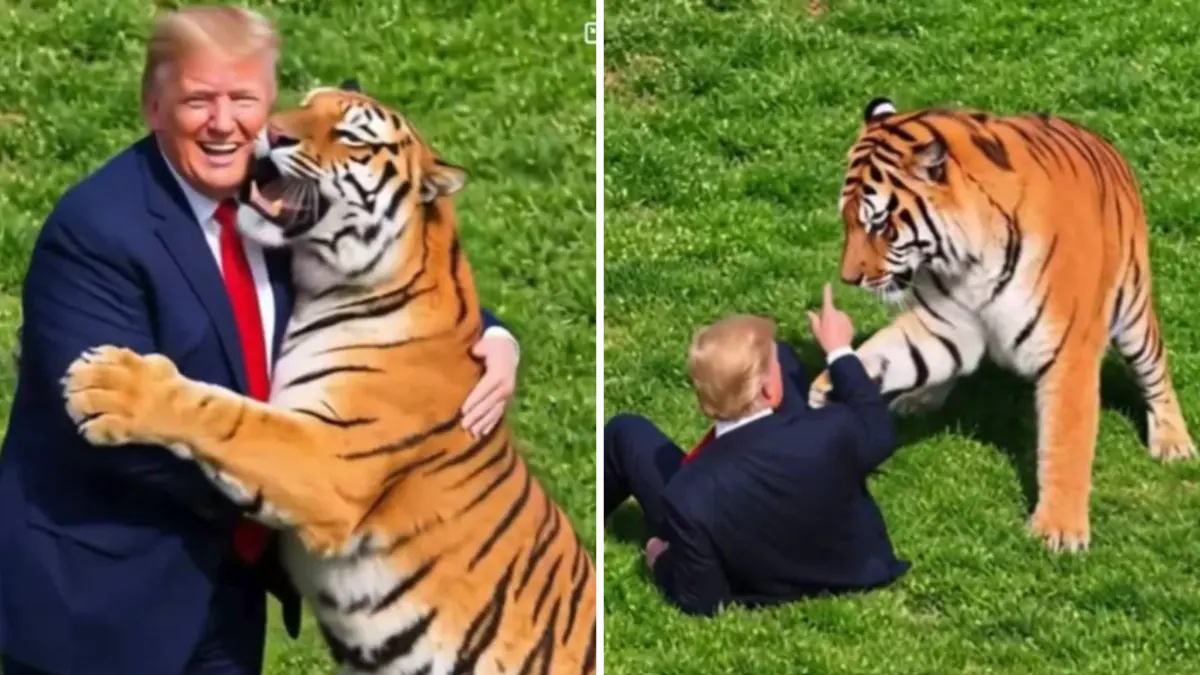
US President Donald Trump is facing criticism after sharing an AI-generated video of himself playing with a tiger, shortly after posting footage of a fatal tiger attack at a wildlife park in the United Kingdom. The controversy has sparked debate about social media responsibility, artificial intelligence and respect for grieving families. The reaction intensified after the victim’s family reportedly appealed to the public to stop circulating the disturbing footage of the incident.
The episode has drawn attention not only because of Trump’s online posts but also because of the timing. While some social media users viewed the AI-generated clip as humour, others considered it insensitive given the circumstances and the family’s request for privacy.
What Did Donald Trump Post on Social Media?
According to the report published by News18, Trump shared an AI-generated video on his Truth Social account during a series of late-night posts. The clip showed a digitally created version of Trump approaching a tiger, chasing it away and then playing with and hugging the animal.
The video ended with the song The Lion Sleeps Tonight, adding a humorous element to the scene. However, the clip appeared shortly after Trump had shared footage of a real and fatal tiger attack at a British wildlife park.
In his earlier post, Trump reportedly wrote, “Don’t ever mess with nature!”
The contrast between the two posts quickly became a talking point. One showed a real-life tragedy involving a person and a wild animal, while the other presented a fictional, AI-generated interaction with a tiger.
For critics, the timing raised questions about whether such content was appropriate when a family was mourning a loved one. Others viewed the video as an attempt at humour rather than a deliberate effort to offend.
What Happened at Yorkshire Wildlife Park?
The incident took place on October 10, 2026, at Yorkshire Wildlife Park near Doncaster, England, according to the supplied report.
A man reportedly entered a tiger enclosure and was fatally attacked by an Amur tiger named Altai. Emergency services attended the scene, but the man was declared dead despite the response.
The park was evacuated as authorities began examining the circumstances surrounding the incident. Reports stated that the tiger remained safe following the attack.
The available information does not establish why the man entered the enclosure or provide a complete account of the events leading up to the tragedy. It is therefore important not to speculate about his intentions or the precise circumstances.
Wild animals, including tigers, remain unpredictable even when cared for in managed environments. Enclosures and barriers are designed to separate visitors from animals and reduce the risk of dangerous encounters. Entering restricted areas can expose people to potentially fatal danger.
The incident has also renewed attention on wildlife safety and the importance of following park rules. Visitors should never cross protective barriers or enter animal enclosures, regardless of how calm an animal may appear.
Why Did the Victim’s Family Ask People to Stop Sharing the Video?
The victim’s family reportedly made an emotional appeal asking people not to share footage of the fatal attack online. According to the report, the continued circulation of the video was causing them considerable distress as they tried to process their loss.
For families dealing with a sudden death, seeing graphic images of the incident repeatedly shared across social media can make an already painful experience even harder. Such footage may reach relatives, friends and children without warning, sometimes accompanied by insensitive comments or sensational headlines.
The family’s request highlights a wider issue with viral content: a video can attract millions of views while the people most affected by it are left dealing with the consequences.
Sharing a clip may take only seconds, but removing copies from multiple platforms can be difficult once it spreads. Even when footage is already publicly available, that does not automatically mean that resharing it is respectful or necessary.
The family’s appeal has therefore become an important part of the discussion surrounding Trump’s posts. It has prompted questions about whether social media users, publishers and influential public figures should consider the emotional impact of sharing graphic material.
Why Is Trump’s AI Tiger Video Facing Criticism?
The backlash centres largely on the timing and contrast between the real incident and the fictional video.
Critics argue that posting a playful AI-generated tiger video so soon after sharing footage of a fatal attack could appear insensitive, particularly when the victim’s family had reportedly asked people to stop circulating the real footage.
Some online users expressed support for Trump, describing the clip as humorous and arguing that public figures should be allowed to share light-hearted content. Others questioned the decision, saying that the circumstances called for greater sensitivity.
The disagreement reflects a broader divide over how people interpret humour during tragic events. One person may see an AI-generated video as harmless entertainment, while another may view it as disrespectful because of its connection to a recent death.
The context matters. Content that might ordinarily be considered a joke can be received very differently when a real family is grieving and distressing footage is still circulating.
The criticism does not, by itself, establish that Trump intended to hurt the family. Rather, it shows how the timing and presentation of a social media post can influence public reaction, especially when it comes from a prominent political leader.
How Did Social Media Users React?
The response online was mixed, with some users defending Trump’s sense of humour and others criticising the video as inappropriate.
One supporter reportedly praised the clip, saying that it was refreshing to see a president with a sense of humour. This reaction reflects the view that an AI-generated video should be understood as entertainment rather than as a comment on the victim’s death.
Other users were less forgiving. Some criticised the use of AI-generated imagery while people were facing serious difficulties, while others focused on the family’s reported request not to share the distressing footage.
Another criticism centred on the contrast between the family’s appeal for privacy and the continued online attention surrounding the incident.
These reactions demonstrate how quickly a tragedy can become part of a wider political and cultural argument. Instead of focusing only on the original event, conversations can shift towards a public figure’s behaviour, the ethics of viral content and the role of social media in shaping public opinion.
The online responses cited in the report represent individual opinions rather than a complete picture of public sentiment. Nevertheless, the disagreement shows that audiences increasingly expect prominent figures to consider the wider context of their posts.
What Does This Controversy Reveal About AI-Generated Content?
Artificial intelligence has made it easier than ever to create realistic-looking videos of public figures interacting with people, animals or situations that never happened.
Such videos can be created for comedy, entertainment or political commentary. However, they can also confuse viewers when they are shared without a clear explanation that the footage is artificial.
In this case, the tiger video was described as AI-generated. That distinction matters because viewers should not mistake a digitally created scene for a real event.
The controversy also highlights an important question: should public figures take extra care when sharing AI-generated content connected to a recent tragedy?
There is no single answer for every situation. However, clearly labelling synthetic content and considering its timing can help prevent confusion and unnecessary distress. A video being technically fictional does not mean its wider context is irrelevant.
Why This Issue Matters to Social Media Users in India
The debate has relevance for Indian social media users, where dramatic videos, celebrity posts and political controversies can spread rapidly across platforms such as Instagram, Facebook, YouTube and WhatsApp.
For example, an AI-generated clip of a politician interacting with a dangerous animal could be shared as a joke. If viewers do not realise that the scene is artificial, they might believe it actually happened. Similarly, real footage of an accident can be repeatedly forwarded without considering the privacy of victims or their families.
These situations raise two separate concerns: whether content is genuine and whether sharing it is responsible.
Indian users can help by checking the original source, looking for reliable news reports and avoiding the forwarding of graphic footage simply because it is attracting attention. When a family has explicitly requested privacy, respecting that request can be more important than being among the first to share a viral clip.
The same principle applies to content involving road accidents, natural disasters, animal attacks and other tragic events.
The Bigger Question: Where Should We Draw the Line?
The controversy involving Trump and the AI-generated tiger video is about more than one social media post. It highlights the growing tension between online entertainment, political communication and respect for people affected by tragedy.
Public figures have the same ability to share content as other users, but their posts often reach much larger audiences. That reach can bring greater scrutiny, particularly when their content appears alongside a recent and distressing event.
At the same time, criticism should be based on the available facts rather than assumptions about someone’s intentions. The timing of a post can reasonably be questioned without claiming to know what the person intended.
Ultimately, social media users and influential public figures alike face a simple choice: share content only for its potential to attract attention, or consider its effect on the people connected to the story.
The key takeaway: AI-generated videos may entertain millions, but the real people affected by a tragedy should not be forgotten in the rush to make content go viral.